
Link to the serious game I created for this study
My full Thesis:
Introduction
Most people know someone with ADHD, but most people have no idea what it is like to have ADHD. This lack of understanding can cause stigma, frustration, and even damage to relationships. Research shows that people with ADHD struggle more when they don’t have proper support from those around them. increasing empathy and knowledge could improve support for people with ADHD. In my thesis, I explore whether a serious game can help non-ADHD individuals better understand what it’s like to have ADHD. The serious game simulates some of the struggles people with ADHD face. By letting players experience these symptoms themselves, the game tries to improve knowledge, empathy, and willingness to help people with ADHD.
Research Questions
- Can serious games be used to increase knowledge of ADHD?
- Will playing a serious game that simulates the ADHD experience increase cognitive empathy towards individuals who have ADHD?
- Will playing a serious game that simulates the ADHD experience cause participants to be more willing to help individuals who have ADHD?
Game Description
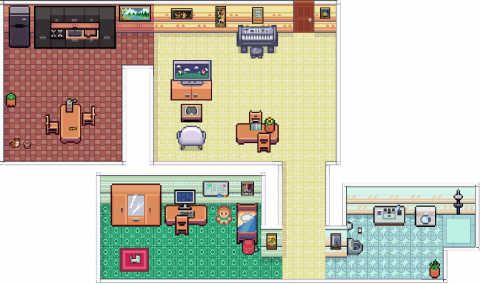
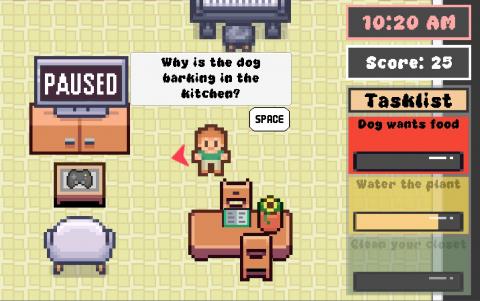
The goal of the serious game is to simulate how it is to have ADHD. The player is asked to complete tasks before an appointment, but as the character has ADHD, it is hard to be on time. The main way ADHD is simulated is through the tasklist. The character gets constantly distracted causing tasks to change and making it hard to complete them. The serious game is chaotic, fast-paced, and frustrating on purpose, to show the real-life challenges of ADHD.
User Study
32 participants took part in the study. They had to fill in a pre and post-questionnaire and play the serious game in between to see if knowledge, empathy, and willingness to help improved. I created my own test to measure knowledge, while existing scales were used to look at empathy and willingness to help. The empathy scale measured perspective taking and online simulation, while the willingness to help scale looked at kindness and indifference. Furthermore, Open questions and background information were also asked to give more context to the results.
Results
Kindness was the only component that had a significant increase, which is part of willingness to help. This suggests that even a short, chaotic serious game can help players be more supportive and help people with ADHD. While empathy and knowledge levels also improved, the changes were not large enough to be considered statistically significant, meaning only research question 3 was partly proven.
Findings
The results show that simulating ADHD through gameplay can increase willingness to help partly, but may not be enough on its own to significantly boost empathy or knowledge. However, a big longitudinal is needed to see the effect more clearly. As the thesis shows that a short play session may not be enough to create lasting change in empathy or knowledge. More directly showing the symptoms and having more reflection time is also needed to have a bigger impact.